Inclusion & NeurodiversityArmed Forces Transition & Employment
What I wish Schools Knew!
Support Needs of Service Children!
4 August 2026
Turning military experience into meaningful civilian opportunity
Transition is about more than finding the next job.
Leaving the Armed Forces can be a significant shift.
It can mean moving away from a familiar structure, identity, language and way of working, while trying to understand where your experience fits within a completely different employment landscape.
For employers, it can also be difficult to understand the depth of skills, leadership experience and capability that service leavers and military families bring.
At Careers Ideas, we work across employment, education and the Armed Forces community to help bridge that gap.
As an Army veteran herself, Deborah brings lived experience alongside extensive professional expertise, helping individuals better understand and communicate their value while supporting organisations to recognise military talent more effectively.
Skills gained in service do not disappear when military life ends.
These are all highly valuable in civilian workplaces.
But the language used to describe them within the Armed Forces does not always translate easily into the language employers use.
A service leaver may have years of significant responsibility and still struggle to explain how that experience relates to a civilian role.
An employer may receive an application from a highly capable candidate without fully understanding the level of experience behind it.
Deborah helps make those connections clearer.
The aim is not to rewrite military experience into something it is not.
It is to help people recognise, articulate and communicate the value of what they already bring.
There is no single route from military life into civilian employment.
For some people, transition feels exciting.
For others, it can bring uncertainty around identity, confidence and direction.
Some know exactly what they want to do next.
Others may have spent years following a clearly defined career structure and suddenly find themselves faced with an overwhelming number of choices.
There may also be wider factors to navigate, including family circumstances, location, qualifications, health, confidence or a shift in what someone now wants from their working life.
That is why Deborah’s approach does not start with a generic list of job opportunities.
It starts by understanding the individual.
And where could those strengths take you next?
Strong candidates can be missed when experience is misunderstood.
Supporting Armed Forces employment is not only about preparing candidates.
Employers also have a role to play.
Recruitment processes can unintentionally favour familiar career paths, job titles and language.
Military candidates may describe significant leadership, operational or technical experience in terms that do not immediately match a civilian job description.
Employers may also make assumptions about military backgrounds that limit the opportunities available.
Careers Ideas helps organisations look more closely at:
Understanding how military experience maps across to civilian roles and responsibilities.
Exploring whether job descriptions, application processes or interview approaches may unintentionally create barriers.
Helping managers and recruiters better understand military backgrounds and the value different candidates can bring.
Recognising that successful recruitment is only the beginning and that onboarding, communication and workplace culture can influence how well someone settles and progresses.
Helping organisations identify where Armed Forces talent could strengthen existing and future workforce needs.
The Armed Forces community is wider than those leaving uniform.
Military life can shape the careers and opportunities of whole families.
Spouses and partners may experience frequent moves, disrupted employment or difficulties building continuous career progression.
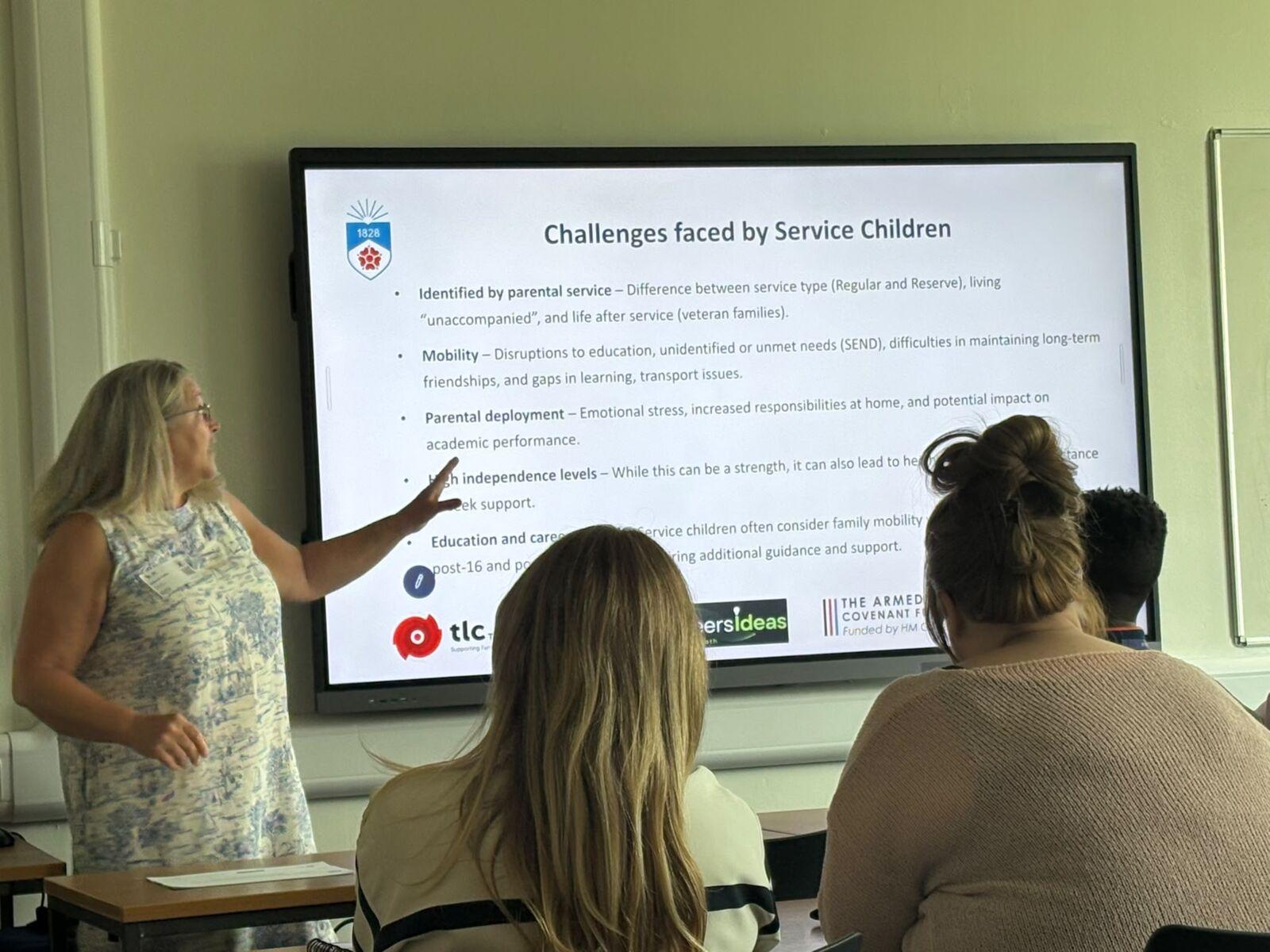
Children from service families may move between schools and education systems, affecting continuity and support.
Veterans may continue navigating career change or progression long after their initial transition.
That is why Deborah’s work considers the wider Armed Forces community, including service leavers, veterans, spouses, partners and military-connected families.
Her work brings together employability, education, inclusion and lived experience to better understand where barriers sit and how stronger pathways can be created.
Combining personal perspective with professional expertise
Deborah’s work in this area is shaped by her own experience of leaving the Army and moving into civilian employment.
But lived experience is only one part of the picture.
Her work also draws on decades of experience across HR, recruitment, education, employability, leadership and organisational development, alongside research and collaboration across the Armed Forces community.
This enables her to see transition from multiple perspectives:
The individual trying to understand what comes next.
The family adapting alongside them.
The employer looking for talent.
The education provider supporting military-connected learners.
And the organisation trying to turn Armed Forces commitments into meaningful action.
That broader perspective helps Careers Ideas move beyond awareness and towards practical change.
Real conversations about life beyond the military
Deborah created Mission Employable UK® to open up honest conversations about military transition and civilian employment.
The podcast brings together lived experiences, employers, specialists and members of the wider Armed Forces community to explore the realities behind the transition process.
Topics extend beyond simply finding work, touching on areas such as transferable skills, confidence, qualifications, family life, employer understanding and the different routes people take after service.
At its heart, Mission Employable UK® is about helping people feel better informed, better understood and better equipped for what comes next.
Practical support for individuals, organisations and the Armed Forces community
Deborah works with employers, education providers, public sector organisations and Armed Forces communities to strengthen transition and employment outcomes.
Support can include:
Practical sessions designed around areas such as transferable skills, employability, career transition, employer understanding and military talent. Workshops can be tailored for service leavers, veterans, spouses and partners, employers or professionals working with the Armed Forces community.
Support for organisations exploring Armed Forces employment, education, transition or workforce challenges. Deborah brings together research, lived experience and stakeholder perspectives to identify barriers, opportunities and practical recommendations.
Insightful and thought-provoking talks for employers, professional networks, conferences, education providers and Armed Forces organisations. Talks can explore military transition, transferable skills, employment barriers, lived experience and the role organisations can play in improving outcomes.
Armed Forces Transition & Employment support can be particularly valuable for:
Individuals need to understand employers. Employers need to understand individuals.
Transition can often be presented as something the service leaver must solve.
All of those things can help.
But successful transition also requires employers and organisations to recognise where their own systems, language or assumptions may create unnecessary barriers.
When both sides understand each other better, stronger matches can be made.
People are more likely to find roles where their experience is valued.
Employers are more likely to recognise talent they might otherwise overlook.
And transition becomes less about fitting somebody into an existing mould and more about understanding what they can bring.
Armed Forces transition connects directly with many of the wider challenges Careers Ideas works across.
Deborah’s experience across these areas allows her to look beyond a single point of transition and consider the wider systems around it.
Because creating better employment outcomes means supporting individuals while also helping organisations become better at recognising potential.
Start with the challenge you are trying to solve.
You may want to help service leavers better communicate their experience.
Strengthen your organisation’s approach to Armed Forces recruitment.
Improve career pathways for military spouses and partners.
Develop your understanding of transferable skills.
Or explore where barriers may exist across education, employment or transition.
Deborah can help you understand the challenge, connect the different perspectives and identify practical ways forward.
Explore more ideas, research and practical perspectives from Deborah.
Support Needs of Service Children!
4 August 2026
Career Insights with local Cadets!
8 July 2026
Seeing the unseen: Supporting Military connected Students at B&FC
8 July 2026